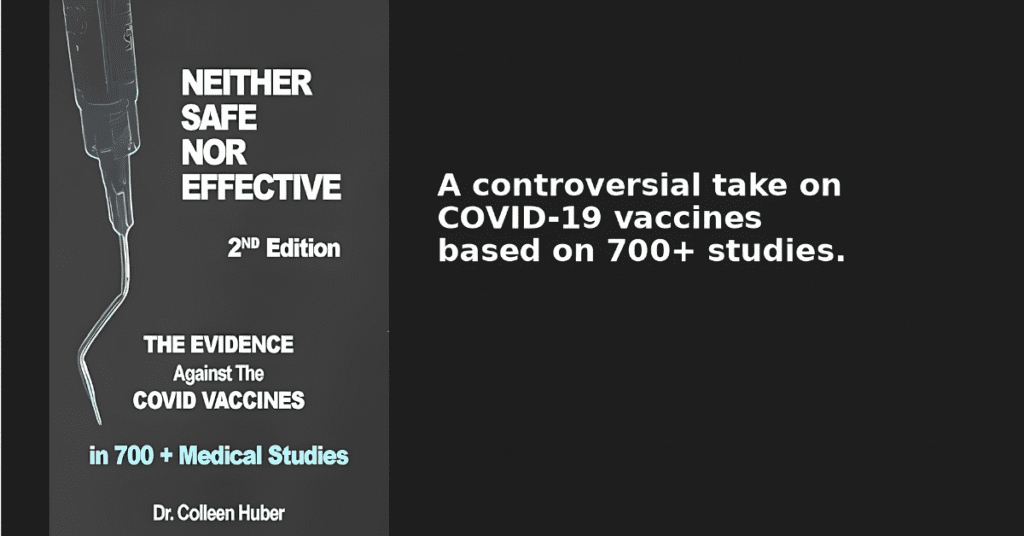
Title: Neither Safe Nor Effective
Author: Dr. Colleen Huber
Genre: Nonfiction—Medical Analysis/Public Health Critique
Theme: A bold, evidence-driven challenge to vaccine safety and public health orthodoxy.
Audience: Skeptical readers, medical professionals, and critical thinkers exploring alternative COVID-19 perspectives.
ASIN: B0C7VYCDWY
👉Read on Goodreads
👉 Browse All Reviews on My Website
👉 See Full Review List on Google Site
When Science Develops Personal Interest
First, drawing my eye to this book was not the strong title. The secret was the name: Dr. Colleen Huber, a naturopathic physician with a background in clinical practice, court, and medical freedom writing. The worries of a medical practitioner about COVID-19 vaccinations piqued my interest. In a society where pandemic stories are usually presented as either positive or negative, this book caught my attention since it promised to investigate the complexity in between.
To be clear, “Neither Safe Nor Effective” calls for your concentrated attention; it is not light weekend reading. It is densely information-rich, bursting with facts, and boldly explores divisive subjects. The book is excellent because it questions accepted wisdom and is for those who value integrity in healthcare, bodily autonomy, and facts contradicting conventional wisdom. There is a rebellious thinking in the air.
Important Concepts That Clearly Outstanding
This book is essentially a critical analysis of the effectiveness and safety of COVID-19 vaccinations. Dr. Huber assembled this work using more than 700 sources—scientific publications, government records, clinical experiences, plus her own observations of Arizona practices.
Some of the most eye-opening parts explore the intricate biological routes and responses of ailments allegedly brought on by immunizations. Dr. Huber breaks out the science of mRNA vaccinations, including how the spike protein functions and possible adverse effects, including myocarditis, blood clots, and fertility problems. Furthermore, it thoroughly examines how these systems might be related to future health hazards, including cancer and compromised immune systems.
One very remarkable section of the book carefully details each criterion and its application using the Bradford Hill criteria, a well-known scientific framework for determining causality to vaccination injuries. Her rigorous and forceful technique is indisputable, though readers like me may disagree with her interpretations.
Finding a chapter on research from her clinic about secondary vaccine effects—that is, people becoming sick following contact with vaccinated individuals—surprised me. Though not always verifiable for casual readers, the book’s anecdotal material offers a strong, realistic point of view.
My Straight Views
This book seemed like a heated conversation with someone weary of opposition but nonetheless driven to be heard. It doesn’t read like a standard anti-vaccine brochure. It reads more like a doctor presenting a diagnosis—direct, honest, and free of sugarcoating.
The book avoided depending just on personal viewpoints, which appealed to me. Citing research from prestigious publications, including NEJM, JAMA, BMJ, and The Lancet, the paper includes graphics, footnotes, and several case studies. Whether one agrees with Dr. Huber’s findings, her work shows notable investigation and preparedness.
Sometimes, I stopped because the claims were strong, not because of the scientific difficulty, but extremely severe assertions are made when one suggests that vaccinations are bioweapons or that those who have been vaccinated shed dangerous proteins. Sometimes, it seems to me they are overstretching it. That is the tightrope dance of the book: between challenging medicine and projecting a conspiratorial attitude.
Maybe the book’s contentious character results from its forthright, evidence-based presentation of contradicting points of view, something we’re not used to.
Room for Balance
Even if the text is interesting, some opposing points of view would have improved it. Once more and once more, the book’s chapters highlight the same issue: the public has been misled, and vaccinations are risky. Though the book’s thesis clarifies this emphasis, I hoped for a fairer debate, such as a comparison of risks for vaccinated against unvaccinated COVID patients, or a more careful investigation of why other nations had different outcomes.
Furthermore, other parts highly rely on emotional appeals and prejudices, especially in relation to media cooperation, compulsion, or mandates.
Though the author’s enthusiasm comes through in some parts, occasionally, it takes away from the book’s originally analytical tone.
Final Look
Though contentious, I think *Neither Safe Nor Effective* presents a bold, thorough, and meticulous study of its topic. It is here to confront, not to calm. I so advise anybody open to challenging views, especially now when doubts about public health messaging can seem dangerous.
This book will be valuable to doctors, policy analysts, and anybody else who lived through the recent upheaval and seeks another viewpoint. Read it with an analytical but open approach.
You have no need to defend the truth. Let it guard itself.
“This — A passage from a book that truly stayed with me.”
Though a little bit combative, this book explores public health and vaccinations in great detail.